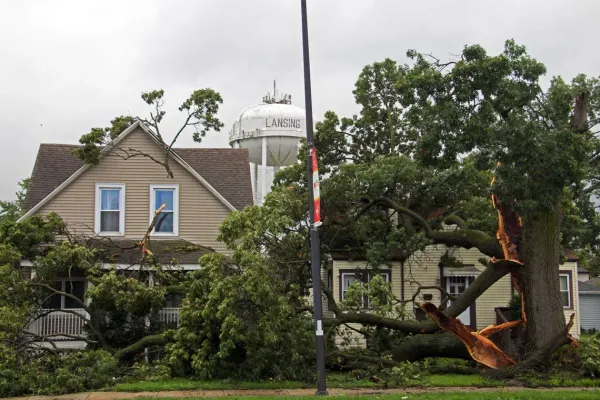
Storms are over. Here's how Cook County homeowners and renters can get insurance, food, utility and other help
The power's back. Here's what Cook County homeowners and renters need to know now: insurance, food, utility bills and rebuilding after this summer's storms.

What's inside:
- Power & shelter
- Renters
- Food & emergency help
- Utility bills
- Insurance, taxes & fees
- Mental health support
- Federal & county aid, explained
- County damage survey
- Before you hire anyone
The electricity is back on. Gov. JB Pritzker declared the communities hit by the late July and early August tornadoes and storms a disaster area. Federal funding awaits.
But trees need to be cleared, generators paid for, food replaced — and all the rebuilding ahead.
What do you do? Where can you get help?
Whether you own a home, or rent, need utility help or a break in fees, we have new resources to help you navigate picking up the pieces of your lives after this summer’s devastation. You can also check our first guide that contains critical local contact and other information.
This page will be updated as new information becomes available. If you have a tip, would like to be added to this list, or have a correction, contact erika@erikahobbs.com. Note: This story has been updated to include tax fee relief, new Red Cross location information and a Red Cross Aid event tomorrow in Glenwood.
Power and shelter help
Power:
ComEd reports that restoration from the August 11-12 storms is 99% complete. At the peak, more than 370,000 customers lost power across the region. However, if you're still without power, check ComEd's live outage map, text OUT to 26633, or call 1-800-EDISON-1 (1-800-334-7661).
If your house still shows no power AND a wire is down or detached from your home: the line from the pole up to the point it attaches to your house is ComEd's, but the weatherhead, service mast, meter base, and everything past that point belongs to you, the homeowner. If that equipment was damaged, ComEd will not reconnect service until a licensed electrician repairs it, and in many south suburbs, a local building inspector has to sign off first. See ComEd's Equipment Responsibility page for the exact breakdown of what's theirs versus what's yours, and call an electrician directly rather than waiting on ComEd to fix something on your side of the meter.
If your cable or internet is still out: Xfinity's Status Center covers Comcast service, and AT&T's outage page covers AT&T internet, U-verse, and wireless. If the maps shows no outage but your service is still down, that's likely a line specific to your house, and you'll need to call your provider directly to get a technician out. Xfinity also runs a dedicated storm response page with WiFi hotspot locations if you need internet access while waiting for a repair.
Shelter:
The American Red Cross opened shelters in south suburban Steger after the July 27 storms for residents displaced by damage or extended outages.
That has now moved to Bethel Community Resource Center at 1250 Portland Ave. in Chicago Heights.
There will also be a community disaster relief event on Friday, August 21st from 12 – 4 p.m. at the Calvary Baptist Church of Glenwood at 801 E. Glenwood Dyer Road, in Glenwood.
"A series of severe storms has uprooted the lives of so many throughout the communities we serve," said Connie Esparza, a spokeswoman for American Red Cross Illinois Region. " The severe weather this summer has brought significant challenges in Cook County."
The Red Cross provides meals, snacks, water, charging stations, a place to stay and other help. Shelter openings change storm to storm, so check the Red Cross shelter map for what's open now, or call the Red Cross disaster support line at 1-800-733-2767.
If you rent and your unit was damaged
The Cook County Residential Tenant Landlord Ordinance covers most rental units in the south suburbs, including Homewood, Flossmoor, Chicago Heights and Harvey.
- Your landlord is required to make repairs within 14 days of written notice.
- If they don't, you have remedies under the ordinance, including in some cases the right to end your lease and find another place to stay if the damage is disaster-related.
- Put your repair request in writing and keep a copy.
Free help for renters may be available:
- Legal Aid Chicago, 312-341-1070, serves Chicago and suburban Cook County. Free for households at or below 150% of the federal poverty line.
- Rentervention, a part of Law Center for Better Housing, is a Chicago area nonprofit that focuses on low-to-moderate income renters in the private housing market. It offers a free chat tool and walks you through repair and habitability issues in plain language. No account is needed.
- Illinois Legal Aid Online, has detailed guides on tenant rights and repair requests.
Want more coverage like this?
Food and other emergency assistance
- Respond Now, 708-755-4357, 1439 Emerald Ave, Chicago Heights. A United Way agency serving 22 south suburban communities since 1969. Provides food, rent and mortgage assistance, utility assistance, prescription medication funds, clothing, transportation and furniture. respondnow.org
- Cook County Sheriff's SHARP team, 312-415-6827. The Sheriff's Housing Assistance Resource Program normally works with residents facing homelessness, but has deployed directly into storm-hit areas, including Country Club Hills after the EF-1, delivering food, water, clothing, toiletries and housing assistance on the ground. A real option for anyone needing immediate hands-on help, not just a referral.
- Together We Cope, 708-633-5040. Serves Harvey, Homewood, Country Club Hills, Hazel Crest, Markham, Oak Forest, Tinley Park and other south suburbs. Food pantry and emergency assistance.
- South Suburban PADS, 708-332-7700, 950 175th St, Homewood. Emergency shelter network and rental assistance.
- Suburban Cook County Homeless Prevention Call Center, 1-877-426-6515, weekdays 8:30 a.m. to 4:30 p.m., myentrypoint.org.
- South Suburban Housing Center, 708-957-4674 ext. 104 for Spanish, 8220 Harwood Ave, Suite 1, Homewood. Fair housing and landlord-tenant issues.
Lost food during a power outage? SNAP can replace it. If you receive SNAP and lost food to a power outage or storm damage, Illinois will replace it. Sign and submit a Request for Replacement of Destroyed Food (Form IL444-1989) to your local Family Community Resource Center within 10 days of discovering the loss. If you don't have proof, the state can verify the outage through your utility company, the Red Cross, or another independent source. Find your local FCRC through the Illinois Department of Human Services.
Utilities
Struggling with utility bills after the storm, whether from lost income, repair costs or a shutoff notice? LIHEAP can help, though it's not a storm-specific fund. The Low Income Home Energy Assistance Program is Illinois' ongoing low-income utility assistance program, run by DCEO, not something created for these storms, but genuinely useful if the damage or its aftermath has strained your ability to pay. Applications are open now closed, but open again in October. It covers natural gas, propane, and electric bills with a one-time payment sent directly to your utility. Apply through your local Community Action Agency or call the Help Illinois Families hotline at 1-833-711-0374. More details can be found at DCEO's utility bill assistance page.

Insurance, taxes, fees and official documents
State tax relief is now available for county residents and businesses Gov. JB Pritzker and the Illinois Department of Revenue announced disaster tax relief Thursday for individuals and businesses in 15 counties hit by summer storms, including Cook and Will counties. The relief waives penalties and interest for taxpayers who cannot file returns or make payments on time because of storm damage. It covers income, withholding, sales, specialty and excise taxes. The Motor Fuel Use Tax is not included. For Cook County, the relief applies to damage from the July 27 and Aug. 9-11 storms. Will County is covered for the same dates.
How to request relief: Taxpayers should send IDOR a brief written explanation of why they cannot file or pay on time. Include:
- Full name
- Account number (if using a Social Security number, only the last four digits)
- Mailing address
- An estimate of when you expect to file or pay
Submit it by email to REV.DisasterRelief@Illinois.gov, or by mail using the address on your return. If mailing, write "Severe Storms - Summer 2026" at the top of the return in red ink and include your explanation.
If you've already been billed for penalties, email REV.DisasterRelief@Illinois.gov with your name, business name, account number and the periods you filed late due to the storms. Include "Severe Storms - Summer 2026" in all communications with IDOR.
Insurance stalling or lowballing your claim? The state can push back. Contact your insurer directly first and document every call, who you spoke to, when and what was said. If that doesn't resolve it, the Illinois Department of Insurance investigates complaints about coverage disputes, delayed payments and unfair claim denials. Call the Consumer Assistance Hotline at 866-445-5364, although complaints themselves must be submitted in writing through idoi.illinois.gov. Insurers have 21 days to respond after a complaint is filed.
Illinois VOAD is a coordinated network of nonprofits doing disaster response statewide. If you're trying to find an established, vetted organization providing hands-on recovery help, not just financial assistance, Illinois Voluntary Organizations Active in Disaster lists current member organizations actively working in the state.
Lost your ID or driver's license in the damage? You can replace it through the Illinois Secretary of State. Having a working ID matters for nearly everything else on this page, filing insurance claims, applying for aid if it becomes available, and proving residency for local assistance programs, so it's worth handling early rather than after everything else.
Need permits for rebuilding? Many municipalities, including South Chicago Heights, are waiving or discounting fees. Check with your village or town clerk.
Mental health
Struggling emotionally with the aftermath? The SAMHSA National Helpline, 1-800-662-4357, is free, confidential and available 24/7 for anyone dealing with the stress of storm damage, displacement, or loss.
The truth about federal and county money
Is federal assistance available yet? No individual assistance has been approved. However, the governor's office says it will file a FEMA application after local damage assessments are complete.
In the meantime, document everything now: photograph all damage before you clean up or make repairs, keep every receipt for temporary repairs or hotel stays and file a claim with your homeowner's or renter's insurance immediately if you haven't already. FEMA assistance, if it’s approved, covers only what insurance doesn’t. Be sure to complete the county damage surveys and register through DisasterAssistance.gov. You may not be approved right away, but you can start the process for when — or if — FEMA is approved in the area.
The $15 million fund you may have heard about: Cook County's Resident Storm Relief Project is real, but it's for residents affected by the 2025 storms, not this year's damage. It's expected to launch this fall. If you were hit in July or August 2026, this program does not cover you.
How to complete the county damage survey
The survey for the August 11-12 storms is open through Monday, August 24. Complete it here.
- It’s available in English, Spanish, Polish, Ukrainian and Mandarin.
- Have your address and a general description of the damage ready. Photos help if you have them.
- This is voluntary and is not a substitute for filing a claim with your insurance company. Completing it does not guarantee assistance.
- It matters: This is the dataset the county uses to pursue state and federal assistance for the region. If your damage isn't recorded, it isn't part of the case for aid.
- This is a different survey than the one that closed August 5 for the July 27 storms. If you submitted that one, you still need to submit this one separately for August damage.
Before you hire anyone
Storm damage draws scammers who target hard-hit neighborhoods right after a disaster.
Verify before you sign anything:
- Illinois requires roofers specifically to hold a state license. Look up any roofer by name or license number before hiring.
- Any contractor offering to waive your insurance deductible is committing fraud under Illinois law. That offer alone is a reason to walk away.
- Illinois law requires a written contract for any repair job over $1,000.
- Get at least two or three written estimates before committing to anyone.
- Never pay the full amount upfront. Standard practice is a partial deposit with the balance due on completion.
- Be wary of anyone who shows up door to door offering a "free inspection." Legitimate contractors generally wait for you to call them.
- Out-of-state plates and no local address or office are warning signs.
If something feels wrong, contact the Illinois Attorney General's Consumer Fraud Hotline at 1-800-386-5438, or file a complaint directly with IDFPR, which can investigate and revoke a contractor's license.